
3D printing has become an essential technology for product designers, engineers, manufacturers, and creative professionals. From developing functional prototypes to producing customized decorations, modern 3D printers offer endless possibilities. However, achieving consistent results requires choosing the right printing material. Among the available options, PLA Plus Filament has become a popular choice because of its improved toughness, smooth printing performance, and versatility.
Traditional PLA is widely appreciated for its easy printing process and attractive surface finish. However, some projects require better resistance to impacts and everyday handling. PLA Plus addresses these requirements by offering an enhanced formulation that improves several mechanical characteristics while maintaining the convenience associated with standard PLA.
What Is PLA Plus Filament?
PLA Plus is an upgraded version of conventional polylactic acid (PLA), a thermoplastic commonly used in fused deposition modeling (FDM) 3D printers. Manufacturers modify the original formulation to improve properties such as toughness, impact resistance, and layer adhesion.
Compared with standard PLA, PLA Plus is designed to produce stronger and more durable printed objects. This makes it useful for projects where models need to withstand regular handling without sacrificing surface quality.
Its relatively straightforward printing requirements also make it suitable for beginners who want dependable results and experienced users working on more detailed designs.
Key Advantages of PLA Plus
1. Improved Strength and Toughness
One of the main advantages of PLA Plus is its improved mechanical performance compared with ordinary PLA. Its modified formulation helps printed objects resist breaking when exposed to minor impacts or everyday handling.
This characteristic is valuable when creating functional prototypes, brackets, equipment housings, and customized components. Although it cannot replace every engineering-grade plastic, it provides a practical balance between strength and printability.
2. Smooth Surface Finish
Surface quality is important when producing professional-looking 3D models. PLA Plus can deliver smooth layers, accurate details, and clean finishes when the printer is configured correctly.
These characteristics make it suitable for architectural models, miniatures, decorative products, and product demonstrations. A polished surface can also reduce the amount of sanding and finishing required after printing.
3. Reliable Printing Performance
Printing problems such as warping, stringing, and nozzle clogging can waste material and interrupt production.
A quality PLA Plus formulation is designed to support consistent extrusion and stable printing. eSUN highlights its upgraded PLA+ formula for reduced warping, clogging, and stringing, helping users achieve cleaner models with fewer printing interruptions.
4. High-Speed Printing Capabilities
Printing speed is important for users producing multiple models or working with limited production time. Modern PLA Plus formulations can support faster printing when paired with compatible equipment.
For example, eSUN lists high-speed printing parameters below 300 mm/s for its PLA+ product. Actual performance depends on printer capabilities, nozzle configuration, cooling, and model complexity.
5. Wide Color Selection
Color availability provides additional flexibility for customized products and creative projects. Different shades allow users to produce attractive models without relying heavily on painting or additional finishing.
eSUN offers more than 40 color options for its PLA+ filament, making it suitable for a variety of artistic and commercial applications.
Common Applications of PLA Plus Filament
The combination of durability, printability, and surface quality makes PLA Plus useful across different industries.
Product Prototyping: Engineers and designers can create physical product models before beginning large-scale manufacturing. The improved toughness helps prototypes withstand regular handling during design reviews.
Creative and Decorative Projects: Artists and hobbyists can produce sculptures, miniatures, personalized gifts, cosplay accessories, and decorative objects. Its detailed surface finish supports attractive results.
Electrical and Electronics: PLA Plus can be used to create prototype enclosures, cable organizers, mounting accessories, and customized electronic housings when the material’s temperature and mechanical properties meet the application requirements.
Educational Projects: Schools and universities can use PLA Plus for robotics models, architectural designs, engineering demonstrations, and classroom activities. Its convenient printing characteristics make it useful for learning environments.
Small-Business Manufacturing: Customized accessories, display products, and small-batch components can be produced with PLA Plus when its properties match the intended use.
Practical Printing Tips for Better Results
Choosing good filament is only one part of successful 3D printing. Proper machine preparation and printing conditions also influence the final quality.
Check the Recommended Temperature
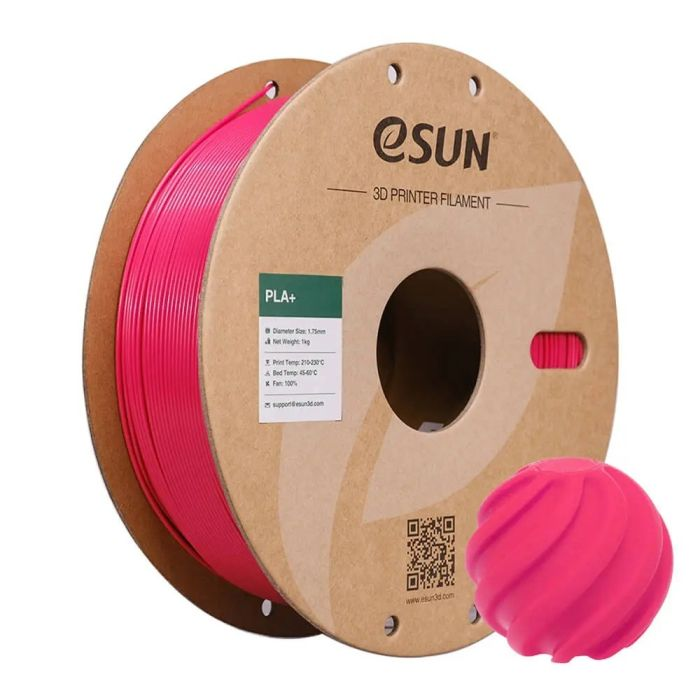
For eSUN PLA+, the recommended extruder temperature is approximately 210–230°C, while the heated bed temperature is 45–60°C. Following these guidelines helps maintain consistent extrusion and proper first-layer adhesion.
Prepare the Printing Surface
A clean and properly leveled build plate helps prevent models from shifting during printing. Good first-layer adhesion is particularly important for larger objects and detailed designs.
Adjust Printing Speed
Although PLA Plus can support high-speed printing, excessively fast settings may affect surface quality. Start with the manufacturer’s recommendations and gradually adjust the speed based on your printer’s performance.
Store Filament Correctly
Moisture can affect filament performance and create printing imperfections. Store PLA Plus in a sealed bag or dry container with desiccant. eSUN recommends drying its PLA+ at 50°C for approximately 8–12 hours when necessary.
Test Before Large Projects
Before starting a complicated model, print a small test object. This helps identify suitable temperature, cooling, and speed settings while reducing unnecessary material waste.
Why Consider eSUN PLA+?
Choosing a reliable manufacturer is important when consistency and printing quality matter. eSUN offers PLA+ designed to provide improved toughness, smooth extrusion, accurate details, and reduced filament breakage.
Its product comes in a 1.75 mm diameter and 1 kg spool, with a wide selection of colors. The material is designed for prototyping, cultural and creative projects, and electrical and electronics applications.
Users interested in exploring its technical specifications, available colors, and recommended printing conditions can visit the official eSUN PLA Plus Filament product page.
Conclusion
PLA Plus Filament offers a useful combination of improved toughness, reliable printing, smooth surface quality, and application flexibility. These advantages make it suitable for everything from creative decorations and educational models to functional prototypes and customized components.
By selecting quality material, following recommended printing settings, and maintaining proper storage conditions, users can achieve more consistent results. For anyone looking to improve their 3D printing experience, PLA Plus is a practical material worth considering.